
Where Compounding Actually Comes From
Everyone talks about “compound interest” and how amazing it is, but I’ve rarely seen anyone talk about where it comes from. With bonds it is fairly straightforward: they pay a contractual amount of interest, and if you reinvest that interest in more bonds, you’ll receive even more interest, and so on. With stocks the picture is much more complicated. Many people have a misconception that compounding comes from reinvesting dividends, but this is not the only way compounding happens. Others may think that compounding comes from price appreciation, but why do stock prices go up over time? Is it just the random mood swings of the market? Is it increasing revenue? For investors accustomed to Brazil's traditionally high dividend yields, this distinction may be especially worth considering.
Let’s say you own a business, and that business pays you $1 million per year. Is that a good business? Well, the answer will depend how much did you have to invest in that business.If you put $2 million into the business, that is a very good business. If you had to put in $100 million to earn $1 million, that’s… not so great. This is the concept of “return on invested capital” or ROIC. Generally speaking, you’d rather earn more profits without having to invest a lot of capital. However, as we’ll see, what the business does with those profits is crucial.
Imagine a restaurant. The restaurant is earning 15% on every dollar invested in the business. The owner can choose to take the profits out of the business like a dividend or open a new restaurant in another part of town. Assume the owner opens a new restaurant which also earns 15% on invested capital, and the owner decides to open a third restaurant, which also earns 15%. This is where compounding really happens. The business is growing at 15% by earning profits and reinvesting those profits to grow the business.
ROIC is a crucial concept, because as Charlie Munger, Warren Buffett’s long-time business partner and friend, said in his speech, A Lesson on Elementary, Worldly Wisdom As It Relates To Investment Management & Business, “Over the long term, it's hard for a stock to earn a much better return than the business which underlies it earns. If the business earns 6% on capital over 40 years and you hold it for that 40 years, you're not going to make much different than a 6% return—even if you originally buy it at a huge discount. Conversely, if a business earns 18% on capital over 20 or 30 years, even if you pay an expensive looking price, you'll end up with a fine result.”
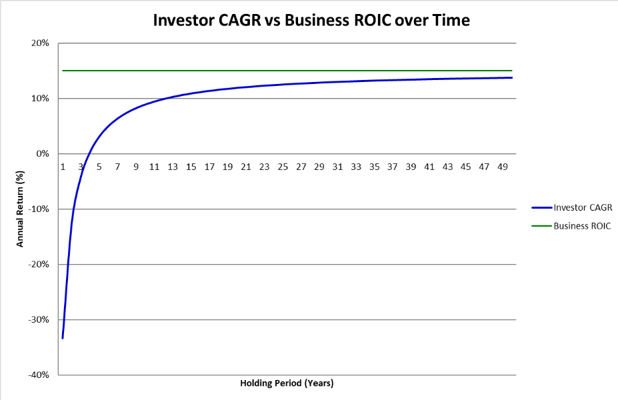
Warren and Charlie are known as “value investors”, meaning they try to buy undervalued stocks. Warren has always credited Charlie with getting him to stop buying bad companies that were very cheap and to start buying great companies at a fair price. For example, assume you buy shares of stock in a business like our hypothetical restaurant with a price-to-earnings (P/E) ratio of 30x today, it earns a 15% ROIC and then you sell it at a P/E ratio of 20x, because for whatever reason the market has assigned a lower valuation to the business. The chart below shows the annual return for different holding periods.
Source: author’s own calculations
For short holding periods, the valuation change hurts a lot. In the early years, valuation is the most important variable. However, as the holding period increases, your annual return moves closer to the 15% ROIC. In this very simple model, if you bought the company at a P/E ratio of 20x and sold it at 20x, you’d expect the annual return to be exactly 15%. If you bought it at a lower P/E ratio and sold it at a higher P/E ratio you’d expect a higher return than 15%.
Now, we’ve made a big assumption that is crucial to this example, and that is that the business can reinvest all their earnings back into the business. But what if the business can’t reinvest profits, or chooses not to?
Warren Buffett has talked many times about See’s Candy, a chocolate maker he bought in 1972. Warren has called it a fantastic business with great returns on capital. The problem with See’s Candy is that they couldn’t reinvest in the business. They tried to expand the company nationally, but for some reason it never caught on beyond the West Coast. Eventually, they stopped trying and just used the profits to purchase other businesses. Let’s go back to our simple example and assume that instead of reinvesting the profits, the business decides to pay a dividend.
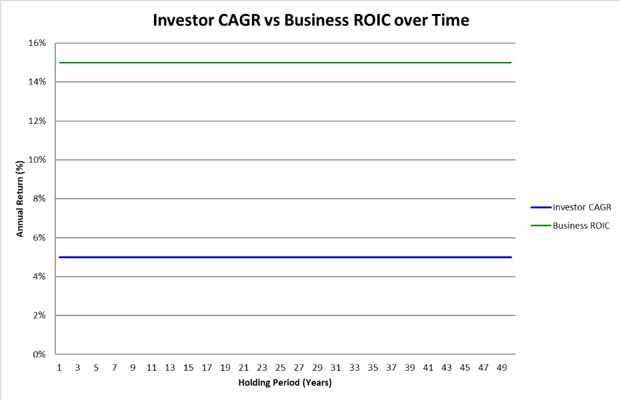
Let’s assume that you have purchased this business at a price-to-earnings ratio of 20x. If you invert that ratio, you get what is called the “earnings yield” which is 5% (=1/20). Think of it this way: Imagine the invested capital in the business is $100 per share. At 15% return on invested capital, earnings are $15. At a P/E ratio of 20, the price of one share of stock is $300. If the company pays out all earnings as a dividend, that equates to a 5% dividend yield ($15/$300), which in this example is equal to earnings yield. This is somewhat confusing, because the ROIC is 15%, but because of the price you pay for the business, the yield on your investment in the company is only 5%. Let’s say you reinvest all the dividends by buying more shares at the same valuation. After 30 years, your compound annual growth rate is… 5%. The key is that you are buying shares in the market, instead of the company reinvesting internally. Because you are paying 20x earnings, you can only get the earnings yield when reinvesting the dividends. Here is the same chart from above with the dividend payout, reinvesting the dividends, and the same 20x valuation throughout.
Source: author’s own calculations
The investment is still compounding, but at 5% instead of 15%. After 30 years of 15% growth you’d have 66.2x your original investment, versus 4.5x at 5%. Now, if the earnings yield is 15%, implying a P/E ratio of 6.67, then the results would be the same, before considering taxes. This is why “growth” companies are not inherently better than dividend payers, but the latter depends more on the valuation to be a solid investment. A company with high returns on capital can still be a mediocre or poor investment at extremely high valuations, if the valuation collapses more than in our example (30x to 20x). To be clear, this is not a real company, we’ve overlooked taxes at both the company level and the investor level, market valuations change daily, and businesses don’t earn the same returns on capital every single year. Reality is of course far more complicated.
Few companies can earn above average returns on capital for 30 years. If people see that a company is earning high returns on capital, they’ll want to start their own company and compete with that business for those juicy returns. If the original business doesn’t have some unique way to fend off the challengers, eventually their returns will decline. Going back to our restaurant example, after noticing that the original restaurant seems to be very busy and the owner is successful, someone might open their own restaurant across the street. A company needs a unique reason that no other companies can compete with them to maintain high returns on capital for many years. This is what Buffett calls a “moat.” There are also macroeconomic factors that affect businesses like inflation, recessions, weather, and wars. Earnings will fluctuate over time, making it hard to determine which companies will earn above-average returns for decades, and which will regress to the mean.
When you buy all the companies in the index, a handful of these companies will be exceptional, many will be average, and many will be in decline. A study by Hendrik Bessembinder found that in 100 years of U.S. stock market history, $91 trillion in wealth was created for shareholders in total, and just 46 companies account for half of that (Bessembinder, Hendrik (Hank), “One Hundred Years in the U.S. Stock Markets”, March 18, 2026). This shows that historically the few exceptional companies have more than overcome the many average and decaying companies in the market, as any chart of the S&P 500 over time will show – although as always, past returns do not guarantee future success.
Understanding how compounding works might help you to be comfortable with the volatility that comes with owning stocks, and to dispel the myth that compounding comes only from dividends. Dividends can be a sign that a company has fewer opportunities to reinvest in the business, which could mean that growth is slowing or reversing. Dividends can be a sign of profitability, but even that is not always true as some companies borrow money to pay their dividend, which sometimes proves to be unsustainable. At the right valuation, however, dividends can be a driver of compounding, and paying dividends might be the right thing for the business to do rather than reinvest profits at lower returns on capital or buy back shares at high valuations. Owning a well-diversified portfolio of both growth and dividend paying stocks might be an important part of achieving your financial goals.
This post is for educational purposes only and does not constitute personalized investment advice. Past performance is not indicative of future results. Planalto Financial LLC is a registered investment adviser in the state of Alabama.